 +91 7014607737
 info@technoloader.com





Table of Contents
Key Takeaways:-
- STOs combine the benefits of blockchain technology with regulation. They mix the efficiency of blockchain and the legal protection of traditional securities, which makes fundraising more secure and transparent.
- These are a more reliable alternative to ICOs. Unlike ICOs, STOs are backed by real assets and comply with regulations, which reduce the risk of scams and fraud.
- Multiple types of security tokens exist. STOs can represent equity, debt, real-world assets, or revenue-sharing models, which offers flexibility for both investors and issuers.
- It provides global access with built-in transparency. Using blockchain in STOs allows people to track ownership and transactions in real-time. It also allows investors from various areas to join in.
- STOs provide better liquidity compared to traditional investments. Secondary trading of security tokens provides exit opportunities that are often missing in private markets.
- STOs come with their own set of challenges. Regulatory complexity, legal costs, investor restrictions, and smart contract risks are some of the factors that businesses must consider.
Introduction
Raising capital has never been simple.
If you are a startup founder, you already know the drill: pitch decks, investor meetings, legal paperwork, more meetings, and endless paperwork.
On the other side, the crypto world promised a shortcut. ICOs (or Initial Coin Offerings) exploded between 2017 and 2018, which helped people raise billions overnight. According to a report by Crunchbase, almost $4.9 billion was raised through ICOs in 2017.
It felt revolutionary. But, then came scams, rug pulls, and regulatory issues that wiped out billions of investor’s funds.
So, is there a better way left? That’s what STOs (or, Security Token Offerings) offer!
An STO offers the best of both worlds. It takes the speed, programmability, and global reach of blockchain technology and wraps it in the legal protections and regulatory compliance of traditional securities.
But, what exactly is a security token? How does an STO work? Is it right for you as an investor or as a founder looking to raise capital?
That’s what this guide is here to answer.
So, without further delay, let’s quickly get started!
What is an STO?
STO basically stands for Security Token Offering. It lets businesses or startups to raise funds by issuing digital securities on blockchain technology. Unlike ICOs that sell utility tokens, STOs are basically designed to represent regulated financial instruments in tokens.
You can think of an STO as purchasing shares in a company. But instead of getting paper certificates or using traditional stock exchange platforms, you receive secure digital tokens in your crypto wallet. These tokens are legal and governed by financial regulations, which makes them more trustworthy as compared to earlier crypto fundraising models.
How Does an STO Work?
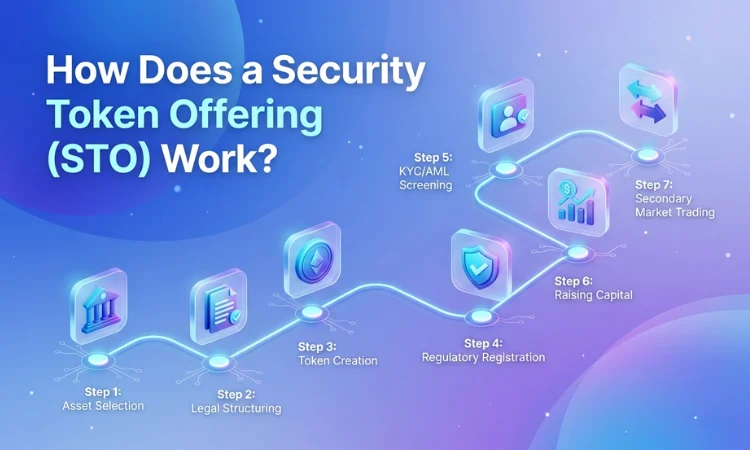
STOs are easy to understand. To grasp them properly, you must know the journey from idea to investor. This will deepen your understanding of STOs. The below mentioned is the process:
Step 1: Asset Selection
The process starts with selecting the asset that will be tokenized. This includes a wide range of valuable assets, such as company equity, real estate, investment funds, and revenue streams.
The goal is to find an asset that can be divided into smaller parts and provided to investors as digital tokens.
Step 2: Legal Structuring
When the asset is chosen, the next step is to define its legal framework. This even includes defining what rights the token holders will get, such as ownership, dividends, profit-sharing, or voting rights.
At this point, companies work with legal experts to make sure the offering follows securities laws.
Step 3: Token Creation
After the legal structure is finalized, digital tokens are created on a blockchain. Some of the most common blockchain networks used for token creation are Ethereum, Polygon, BSC, and more.
These tokens are essentially made using smart contracts that outline how they function, like rules for transferring them, keeping track of ownership, and rights for investors.
Step 4: Regulatory Registration
STOs basically involve securities. Therefore, they must be registered under regulatory authorities like the SEC or SEBI.
This step makes sure the offering meets all legal rules. It also gives clear information and protection for investors.
Step 5: KYC/AML Screening
Not anyone can buy a security token. Every investor must go through KYC (Know Your Customer) and AML (Anti-Money Laundering) checks before participating in STO.
This helps stop fraud and illegal actions, and makes sure that only qualified investors can participate in the STO.
Step 6: Raising Capital
When everything is set up, the STO is launched, and investors can begin buying tokens.
You can invest with either fiat currency or cryptocurrency, which depends on the platform you choose. In return, you will get security tokens that show your ownership or financial rights in the asset.
Step 7: Secondary Market Trading
When the initial sale is completed, these tokens can then be listed on regulated secondary markets or security token exchange platforms.
This allows investors to buy and sell tokens, which provides liquidity. It is something that is mostly limited in traditional private investments.
Types of Security Tokens
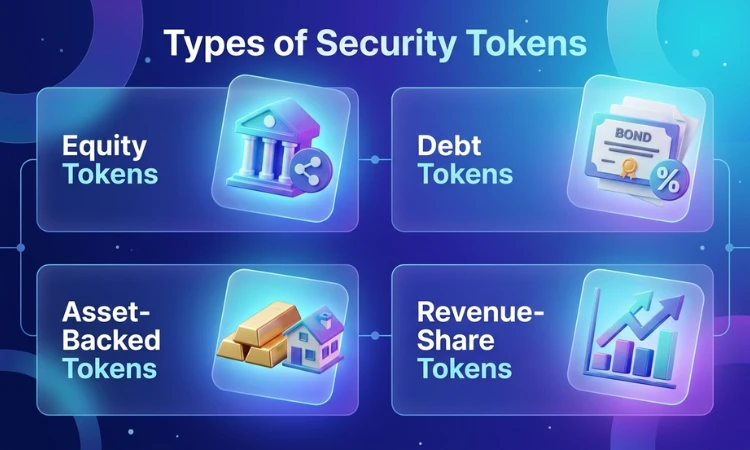
Just like traditional financial instruments that come in different forms, security tokens also come in different types. Each of them represents a distinct kind of ownership or financial right.
The below mentioned are the four main types:
Equity Tokens
An equity token is basically somewhat similar to traditional stocks, except for how ownership is recorded and transferred. Earlier, the tracking of shares is logged in a database, with ownership of shares being printed and certified on paper certificates.
Instead, an equity token is recorded on an immutable ledger, which is kept updated by several computers networked worldwide. The holders of equity tokens are entitles to a portion of the firm’s profit and have a right to vote.
Debt Tokens
A debt token represents a short-term loan on a fixed interest rate. It is basically the funds given by investors as a loan, which could be in the form of real estate mortgages, corporate bonds, or any other type of structured debt.
The price of a debt token is dictated by risk and dividend. As blockchain technology is used, the smart contract is leveraged for debt security. It is used for including repayment terms, dictating the dividend model, and risk factors of the debt.
Asset-Backed Tokens
This type of security token displays the ownership of assets, such as real estate, art, carbon credits, or commodities. Blockchain technology, being secure, immutable, and transparent, ensures a trusted and reliable track of transactions.
This helps reduce fraud and also improves settlement time. Asset-backed tokens are digital assets with features similar to any commodity, including, gold, silver, and oil, which bring value to these traded tokens.
Revenue-Share Tokens
Revenue-share tokens don’t represent company ownership or a fixed loan. Instead, they entitle holders to a percentage of a company’s ongoing revenue or profits.
This model is common in tokenized investment funds, creative projects, and platforms with predictable, recurring cash flows. In this, token holders receive distributions as the business generates income through a smart contract.
STO vs ICO vs IPO: Main Differences
If there is one thing that mostly confuses people is this: What is the difference between STO, ICO, and IPO?
The below is a breakdown of all three:
- ICO (Initial Coin Offering): An ICO is a fundraising method where a company or project sells digital tokens to the public in exchange for capital. These tokens are classified as utility tokens, which means they are supposed to grant access to a future product or service rather than represent ownership.
- IPO (Initial Public Offering): An IPO is typically the traditional way for a company to raise funds from the public by listing its shares on a regulated stock exchange. It is expensive, slow, and accessible only to companies at a particular scale.
- STO (Security Token Offering): An STO lies between the two. It utilizes blockchain technology like an ICO, but issues tokens that are classified as securities like an IPO. That means full regulatory compliance, investor protections, and legal enforceability, combines with the speed, programmability, and global reach of blockchain infrastructure.
| Factor | ICO | STO | IPO |
| Regulation | Largely unregulated | Fully regulated (SEC, FCA, MAS, etc.) | Fully regulated |
| Token/Asset Type | Utility token | Security token | Company shares |
| Investor Protection | Minimal to none | Strong | Strong |
| KYC/AML Required | Rarely | Always | Always |
| Who Can Invest | Anyone | Accredited or verified investors | General public |
| Blockchain-Based | Yes | Yes | No |
| Fractional Ownership | Sometimes | Yes | No |
| Time to Execute | Days to weeks | Weeks to months | 12–18 months |
| Cost | Low | Medium | Very high |
| Secondary Market | Crypto exchanges | Regulated ATS/MTF platforms | Stock exchanges |
| Transparency | Variable | High (on-chain) | High (public filings) |
| Global Reach | High | High | Limited by exchange |
ICO vs STO
The main difference between ICO and STO is that STOs are basically legally registered securities. They are backed by assets, whereas ICOs usually sell utility tokens with minimal regulatory oversight.
STOs comply with securities regulations, which further ensure investor protection. On the other hand, ICOs are mostly unregulated, faster to launch, and also carry higher risk.
STO vs IPO
IPOs and STOs are both methods of raising funds. But IPOs represent traditional and highly regulated equity sales via stock exchanges for mature companies.
STOs are blockchain-based offerings of regulated tokens that provide higher liquidity, lower costs, and fractional ownership for a broader range of assets.
Benefits of STOs
STOs are a better fundraising method, not because of the blockchain buzzword attached to them, but because of the real problems they solve. The below mentioned is the benefits of STOs for both investors and issuers:
For Investors:
Broader Market Access
Earlier, the best investment opportunities weren’t available to most people. Prime commercial real estate, VCs, private equity, and infrastructure assets have long been reserved for institutional players and high net worth individuals. The legal structures were too complex and the entry barriers were too high for anyone outside that circle.
STOs change this through fractionalization. A $50 million commercial property can be divided into thousands of tokens. An investor who couldn’t sign a multi-million dollar cheque can now participate in the same asset class, but at a fraction of the traditional cost.
Real Liquidity
One of the disadvantages of investing in private markets is being locked in for up to seven or ten years. Investors had no exit until an acquisition event or IPO and that never arrive on any predictable timeline. That’s something that investors always didn’t like.
However, STOs introduced a secondary market. This means when a primary offering closes, token holders can trade their positions on regulated platforms, without waiting for a liquidity event that may or may not come.
Built-In Transparency
With traditional investments, transparency depends on what issuers choose to disclose and when. Quarterly reports, annual audits, third-party filings create visibility, but they are mostly backward-looking, periodic, and incomplete.
With STOs, transparency is built into the system. Every transaction, ownership transfer, and distribution is recorded on a blockchain ledger in real time and without the possibility of being altered. This enables investors to verify their holdings, track distributions, and review the cap table at any point.
Regulatory Protection
ICO investors learned the hard way what it means to invest without regulatory protection. Billions were lost to projects that disappeared, teams that vanished suddenly, and tokens that turned out to be worth nothing.
Security tokens are regulated financial instruments. They must follow the securities laws in every jurisdiction where they are offered. Investors go through KYC and AML verification. That means investors have legal recourse if something goes wrong.
Global Investment Access
Traditional investing is geographically restricted. Brokerage accounts are jurisdiction-specific. Foreign investment limits apply. Currency conversion adds friction, cost, and delay at every step.
A security token can be purchased by a verified investor almost anywhere in the world. An investor in Singapore can hold a stake in a US real estate fund. A European institution can participate in an Asian infrastructure token.
For Issuers:
Lower Cost of Capital
A full IPO is one of the most expensive undertakings a company can pursue. Underwriting fees alone typically run between 3 to 7%. And on the top of that, legal, accounting, compliance, and listing costs that can add millions more before a single investor writes a cheque.
STOs reduce that overhead. There are no investment bank underwriters taking a cut off the top. Legal costs are lower. Compliance is partially automated via smart contracts. And the process doesn’t require a listing on a national stock exchange.
Automated Compliance
In a traditional securities offering, ongoing compliance is manual, expensive, and prone to human error. Cap tables need constant maintenance. Transfer restrictions have to be enforced deal by deal. Distributions need to be manually calculated and processed.
With security tokens, the smart contract manages all of this automatically. Only whitelisted, verified wallets can receive tokens. Distributions are calculated and paid on schedule without manual intervention. The cap table updates in real time with every transaction.
Global Reach
Traditional private placements are restricted by geography. Raising capital usually means working through local brokers, attending industry conferences, and relying on introductions to reach the right investors.
An STO is naturally global. This allows issuers to reach verified participants across multiple countries through a single digital platform. That expands the potential investor base and increases competitive demand for the offering.
Retained Control
In traditional venture capital and private equity deals, capital almost always comes with conditions. These include board seats, voting rights, and approval clauses on major decisions.
Whereas, equity tokens can be structured to separate economic rights from governance rights. Issuers can offer investors a share of profits or asset appreciation without giving up decision-making authority.
Faster Settlement
Traditional securities settlement basically runs on a T+2 cycle. This means two business days between a trade being agreed and the actual transfer of ownership and funds. For time-sensitive or high-volume transactions, that lag introduces real risk and real cost.
Security token transactions settle on-chain, in minutes and not days. Ownership transfers, records, and confirmations happen almost instantly. And because it is on the blockchain, there is one authoritative source of truth for every transaction.
Risks and Challenges of STOs
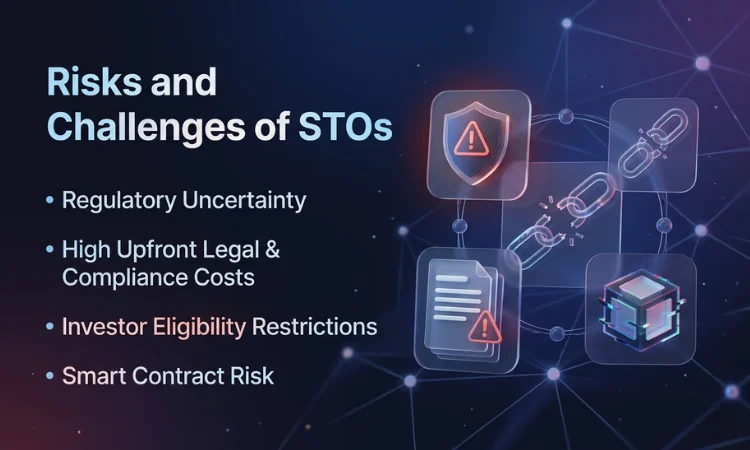
STOs offer a wide range of benefits. But any honest guide has to address the other side of the coin. Let’s check it out one by one!
Regulatory Uncertainty
STOs are regulated. But the rules aren’t the same everywhere, and in many parts of the world, they are still being written.
What qualifies as a security token in the United States may be treated differently in Singapore, the UAE, or Brazil. An STO structured perfectly for one jurisdiction can run into serious compliance problems the moment it tries to reach investors.
High Upfront Legal & Compliance Costs
Structuring a compliant STO still needs securities lawyers, compliance specialists, auditors, and, in many cases, a licensed transfer agent.
Offering documents need to be drafted, reviewed, and filed. KYC and AML systems need to be built or licensed. Smart contracts need to be audited properly for security bugs. All these increases upfront costs.
Investor Eligibility Restrictions
STOs are regulated securities, which means not everyone can participate.
In the Uthe USted States, most STOs are conducted under exemptions that restrict participation to accredited investors. The result is that STOs often end up serving the same institutional and high-net-worth audience as traditional private placements.
Smart Contract Risk
Security tokens are only as reliable as the code behind them. Smart contracts automate compliance, distributions, and transfer limits. But they are software, and software has bugs.
A poorly written or poorly audited smart contract can contain bugs that expose issuers and investors to financial loss, incorrect distributions, or unauthorized transfers.
STO Regulations Around the World
One of the most important things to understand about STOs is that there is no single global rulebook. It differs from one jurisdiction to the other.
Here’s how the regulatory landscape looks across the world’s markets.
United States: SEC
STOs in the US are classified as securities under the Securities Act of 1933, which means issuers must register with the SEC. The most commonly used routes are Regulation D (for accredited investors, no cap on raise size), Regulation A+ (open to retail investors, up to $75 million), Regulation S (for offerings to non-US investors), and Regulation CF (equity crowdfunding, smaller raises).
Switzerland: FINMA
FINMA regulates STOs strictly under existing banking laws and securities regulations, with a strong focus on KYC and AML compliance. Switzerland’s DLT Act, which came into effect in 2021, created a dedicated legal framework for blockchain-based securities. It gives security tokens full legal recognition under Swiss law.
Singapore: MAS
Tokens that are classified as “capital market products” fall under the Securities and Futures Act (SFA) and are regulated by the Monetary Authority of Singapore (MAS). Issuers must comply with prospectus requirements or qualify for exemptions.
European Union: MiCA and MiFID II
The EU is moving toward unified digital asset regulation through the Markets in Crypto-Assets (MiCA) framework. MiCA works alongside the existing MiFID II framework, which already covers traditional securities and even applies to security tokens.
United Kingdom: FCA
The Financial Conduct Authority (FCA) classifies security tokens as “specified investments” under the Financial Services and Markets Act 2000 (FSMA). This means that they are subject to the same regulations as traditional securities. Firms issuing or trading security tokens in the UK must be FCA-authorised.
UAE: VARA and ADGM
In Dubai, the Virtual Assets Regulatory Authority (VARA) oversees the issuance, trading, and custody of security tokens. It requires entities to hold appropriate licences before operating. In Abu Dhabi, the Abu Dhabi Global Market (ADGM) has established its own Digital Securities Framework.
Japan: FSA
Security tokens are regulated under the Financial Instruments and Exchange Act (FIEA) in Japan. It provides full legal certainty for issuers and investors. The Financial Services Agency (FSA) oversees compliance, and Japan has seen growing institutional participation in the STO market.
Australia: ASIC
Australia’s securities regulator, ASIC (Australian Securities and Investments Commission), treats security tokens as financial products under the Corporations Act 2001. Issuers must hold an Australian Financial Services Licence (AFSL) or operate under an exemption, and offering documents must meet the same disclosure standards as traditional securities.
Conclusion
That brings us to the end of this blog!
Raising capital has always been a complicated and time-consuming process. But STOs are making a real difference. They combine the trust and regulation of traditional finance with the speed, transparency, and global reach of blockchain technology.
That said, STOs are not a shortcut or an easy victory. They necessitate appropriate legal structuring, compliance, and technical execution.
So, thinking about raising funds through an STO? Reach out to our experts at Technoloader and let us help you build a secure, compliant, and scalable platform that investors can trust.
Frequently Asked Questions
What is a Security Token Offering (STO)?
An STO is basically a fundraising method where businesses issue security tokens on a blockchain. STOs showcase real financial assets such as equity, debt, or revenue. These are regulated under securities laws, which makes them more secure than traditional crypto offerings.
How is an STO different from an ICO?
The main difference is regulation and asset backing. ICOs typically provide utility tokens with little to no regulation, whereas STOs issue legally compliant tokens backed by real-world assets, which provides better investor protection.
Is an STO the same as an IPO?
Yes, in terms of regulation and investor protection. However, STOs use blockchain technology, allow fractional ownership, and are faster and more cost-effective than traditional IPOs.
Who can invest in an STO?
It relies on the country and regulatory framework. In many cases, only verified or accredited investors can participate, as STOs must comply with KYC (Know Your Customer) and AML (Anti-Money Laundering) regulations.
What kind of assets can you tokenize in an STO?
Almost any valuable asset can be tokenized, which includes:
- Company equity
- Real estate
- Investment funds
- Commodities (gold, oil, etc.)
- Revenue streams
Are STOs a safe investment?
STOs are safer than ICOs since they are regulated and even require legal compliance. However, like any other investment, they also carry risks such as market volatility, project performance, and regulatory changes.
Can STO tokens be traded after they are purchased?
Yes, of course! STO tokens can be traded on regulated secondary markets or security token exchanges. This provides liquidity to investors. It is something that is limited in traditional private investments.
What is the role of blockchain in STOs?
Blockchain provides transparency, security, and unchangeability. It monitors ownership, transactions, and distributions in real-time, which helps reduce fraud and fosters trust between issuers and investors.
How long does it take to launch an STO?
The timeline varies relying on legal and technical requirements, but typically it can take a few weeks to several months, especially due to compliance and regulatory approvals.
Why are STOs regarded as the future of fundraising?
STOs offer the advantages of both blockchain efficiency and the security of traditional finance. They enable global participation, fractional ownership, and transparent transactions, which makes them a powerful alternative to traditional fundraising methods.

Deepa Manwani
Deepa Manwani is a Technical Content Writer at Technoloader with over 7 years of experience creating high-quality content across Blockchain, Web3, AI, and fintech. She specializes in translating complex technical concepts into clear, engaging, and informative content that helps businesses, developers, and users better understand emerging technologies. Her expertise includes writing technical blogs, technical documentation, whitepapers, platform guides, and in-depth content for crypto exchanges, DeFi platforms, trading systems, and enterprise software solutions. At Technoloader, she contributes to developing strategic content that supports product growth, strengthens brand credibility, and educates users about next-generation technologies shaping the future.
Published in Token Development


